 Architrave Journal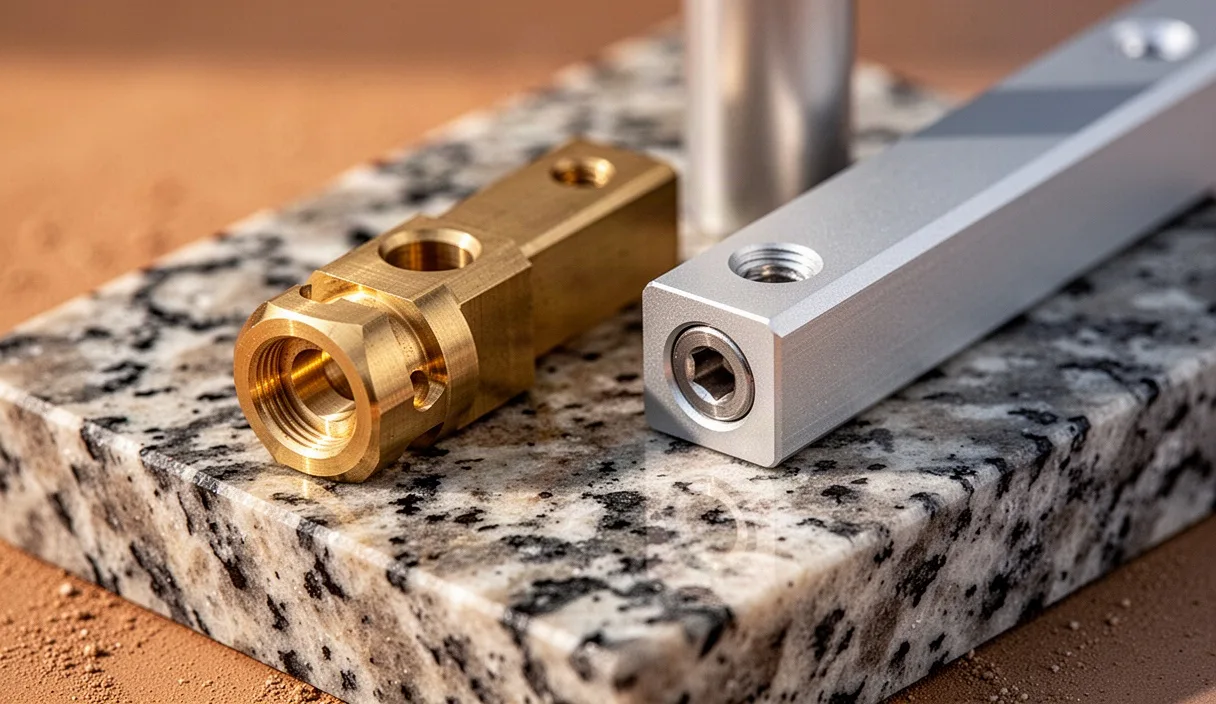
The dialogue between architectural metalwork and structural timber hinges on a predictable relationship with environmental humidity, physical friction, and chemical degradation. In custom casework, oversized entrance systems, and interior partitioning, the selection of operational metals rarely presents itself as a purely aesthetic choice. Behind the surface patina of an unlacquered bronze or the matte neutrality of clear anodized sheet lies a series of metallurgical compromises. Both materials offer distinct modes of survival against mechanical wear, yet they require divergent structural engineering strategies when anchored into solid timber or composite substrates.
Specifiers routinely pit hardcoat anodized aluminum against wrought or cast architectural brass when engineering custom hinges, mortise pulls, pivot points, and sliding tracks. While aluminum relies on an artificially forced, ceramic-like oxide layer for surface resilience, brass functions through the intrinsic bulk properties of a copper-zinc alloy matrix. Examining the thermodynamic, mechanical, and galvanic behavior of these two systems exposes the fundamental trade-offs between surface hardness and structural ductility, offering a clear guide for high-performance interior and envelope detailing.
Electrochemical Properties of Hardcoat Anodizing
Aluminum owes its structural utility to passivity, yet its naturally forming atmospheric oxide film measures merely 2 to 5 nanometers in thickness. For functional joinery components subjected to continuous handling or sliding contact, architectural specification typically mandates Type III hardcoat anodizing in accordance with standards such as MIL-A-8625 or ISO 10074. This electrochemical conversion process transforms the base metal into a hexagonal columnar structure of amorphous aluminum oxide (Al2O3). The process is carried out in an aqueous sulfuric acid bath maintained at low temperatures, typically between 0 and 4 degrees Celsius, utilizing current densities ranging from 2.5 to 3.5 amperes per square decimeter.
Under these conditions, oxidation outpaces chemical dissolution, generating an oxide layer typically specified between 40 and 65 micrometers in depth. This hardcoat penetrates the original surface boundary by roughly half its total thickness while building outward by the remaining half, a dimensional shift that joinery tolerances must strictly incorporate. The cellular pore morphology yields an outward-facing surface hardness of 420 to 520 Vickers (HV), approaching the hardness of hardened tool steel. The base aluminum substrate, commonly an architectural alloy such as 6063-T5 or structural 6061-T6, retains its bulk hardness of 75 to 95 HV, creating an extreme mechanical gradient between the skin and the core.
Crucial to the longevity of hardcoat anodizing is the post-electrolytic sealing stage. Unsealed coatings retain a high volume of open vertical pores, offering exceptional surface keying for specialized lubricants but leaving the component susceptible to chemical staining from atmospheric sulfur and cleaning surfactants. Hydrothermal sealing in boiling deionized water hydrates the oxide into boehmite, closing the pores through volumetric expansion, yet it lowers absolute surface microhardness by roughly 12 to 18 percent. Mid-temperature nickel acetate seals present a widely used compromise, delivering stain resistance while maintaining the structural rigidity of the cellular walls under localized point loads.
Alloy Compositions in Cast and Extruded Brass
Unlike anodized aluminum, whose operational capacity depends entirely on a surface conversion envelope, architectural brass exhibits uniform metallurgical properties throughout its volume. Brass encompasses a broad family of copper-zinc alloys, primarily divided into single-phase alpha brasses and two-phase alpha-beta (duplex) brasses. In high-precision joinery, the method of forming dictates the microstructural composition, yielding noticeable variations in tensile capacity, wear resistance, and long-term chemical stability.
Extruded hardware profiles, including continuous hinge leaves, gear tracks, and perimeter retainers, are overwhelmingly drawn from duplex brasses such as C38500 (architectural bronze) or C36000 (free-cutting brass). C38500 contains approximately 57.0% copper, 40.0% zinc, and 3.0% lead. The high zinc fraction promotes the emergence of the hard beta phase, which offers exceptional plasticity at extrusion temperatures between 650 and 750 degrees Celsius. Lead acts as an insoluble chip breaker, dispersing across intergranular boundaries in microscopic droplets that provide mild self-lubrication, though this phase slightly reduces overall tensile ductility.
Cast hardware, by contrast, relies on alloys tailored for liquid mold flow and intricate geometries, such as the semi-red brass alloy C83600 (frequently termed 85-5-5-5 for its respective percentages of copper, tin, lead, and zinc). Tin additions reinforce the cast matrix against dezincification, a corrosive leaching process that selectively removes zinc in humid, chloride-rich microclimates, leaving behind a brittle, porous copper network. While cast brasses display isotropic material structures with yield strengths between 110 and 150 megapascals, cold-drawn extrusions can exhibit directional yield strengths exceeding 310 megapascals, alongside a surface hardness ranging between 130 and 170 HV.
Galvanic Isolation Standards for Architectural Fasteners
The convergence of timber, mechanical fasteners, and non-ferrous joinery plates creates an active galvanic system whenever ambient relative humidity exceeds 65%. In this environment, timber acts as an electrolytic reservoir, retaining moisture containing volatile organic acids, primarily acetic and formic acid leached from species such as European Oak (Quercus robur) or Sweet Chestnut (Castanea sativa). When dissimilar metals are driven into these substrates, direct metallic contact induces accelerated galvanic decay.
The electrochemical potential difference between the joining elements governs the severity of this degradation. The standard reduction potential of wrought brass sits between -0.20 and -0.30 volts relative to a saturated calomel electrode (SCE), placing it well within the cathodic, or noble, end of the galvanic series. Aluminum occupies a markedly anodic position, registering between -0.75 and -0.90 volts SCE. When an untreated aluminum plate is anchored directly using brass wood screws, or when brass hardware is fastened with plain zinc-plated carbon steel screws, a high-ratio galvanic cell forms over small geometric interfaces.
To eliminate sacrificial corrosion in high-risk joinery installations, specify the following isolation protocols:
- Fastener Metallurgy: Standardize exclusively on passivated Grade 316 (A4) austenitic stainless steel fasteners for both hardcoat aluminum and solid brass installations.
- Dielectric Sleeving: When securing aluminum plates using stainless fasteners, install non-conductive extruded acetal (Delrin) or polyamide (Nylon 6,6) shouldered washers to break direct metal-to-metal continuity beneath the screw head.
- Interfacial Barriers: Apply continuous, solvent-free neoprene, ethylene propylene diene monomer (EPDM), or polyisobutylene gaskets (0.8 to 1.2 millimeters thick) between metal mounting flanges and high-tannin timber substrates.
- Chemical Isolation: Apply an anaerobic barium-chromate-free jointing compound or high-dielectric fluorosilicone barrier paste directly to the fastener shanks prior to mechanical insertion into pilot holes.
Long-Term Wear Characteristics of Pivot Points
The mechanical efficiency of a pivot, whether carrying a 45-kilogram concealed cabinet door or a 280-kilogram timber pivot portal, is governed by boundary lubrication and micro-fretting mechanics. When two sliding surfaces meet under significant cantilevered dead loads, the contact behavior diverges sharply between hardcoat aluminum and solid brass.
Hardcoat aluminum pivot pins operating within aluminum journals present a severe engineering risk: galling. Despite its surface hardness, the aluminum oxide stratum exhibits low fracture toughness and poor cyclic shear tolerance. Under sustained bearing pressures exceeding 15 megapascals, micro-asperities on the hard surface break away, forming loose, microscopic corundum debris. Because aluminum oxide particles are exceptionally abrasive, they act as an unconstrained lap compound, rapidly scouring the underlying substrate. Consequently, an aluminum-to-aluminum bearing interface must never be specified without a sacrificial intermediary bushing, typically sintered bronze (SAE 841) or self-lubricating polyether ether ketone (PEEK).
Solid brass components exhibit substantially different kinematics. The material possesses a natural lubricity, characterized by an unlubricated dynamic friction coefficient against polished steel of roughly 0.28 to 0.35, compared to 0.55 to 0.70 for aluminum. Duplex and leaded brasses absorb sliding energy through localized surface deformation rather than catastrophic brittle fracturing. As wear progresses, microscopic transfers of lead and softer brass phases create an operational glaze across the bearing track. This self-support contact surface resists seizure, even during intermittent lapses in preventative maintenance schedules.
Specification Matrix for Wet and High-Traffic Interiors
Interiors containing elevated atmospheric moisture, airborne salts, or cyclic mechanical impacts demand strict demarcation lines for hardware alloy deployment. Hospitality washrooms, spa changing facilities, continuous-use museum vitrines, and educational assembly halls place distinct strains on both base metals.
| Performance Attribute | Type III Hardcoat Aluminum (6061-T6) | Extruded Duplex Brass (C38500) | Cast Semi-Red Brass (C83600) |
|---|---|---|---|
| Surface Hardness | 450 to 520 HV (Surface Layer Only) | 130 to 160 HV (Through-Hardness) | 70 to 90 HV (Through-Hardness) |
| Resistance to Point Impact | Poor (Susceptible to Substrate Bruising) | Good (Ductile Energy Absorption) | Very Good (High Bulk Mass) |
| Resistance to Acid Cleaners | Very Poor (Pitting Below pH 4.0) | Fair (Forms Verdigris / Surface Etch) | Good (Slight Tarnish) |
| Resistance to Alkaline Cleaners | Very Poor (Dissolution Above pH 8.5) | Good (Minor Discoloration) | Very Good (Resistant) |
| Atmospheric Saline Resistance | High (When Sealed Correctly) | Moderate (Dezincification Risk) | High (Tin-Stabilized) |
| Machinability Post-Finish | Nil (Breaks Protective Oxide Film) | Excellent (Uniform Metallurgy) | Excellent (Readily Reworked) |
Hardcoat aluminum functions effectively in high-traffic administrative joinery where low reciprocating mass is essential to reduce load-induced hinge sagging. It also performs reliably in climate-controlled museum showcases where zero off-gassing can be tolerated. However, in environments subject to caustic chemical wash-downs, such as institutional wet rooms or commercial hospitality bars, hardcoat aluminum surfaces deteriorate rapidly if cleaned with standard industrial solutions falling outside the narrow pH range of 5.5 to 8.0. Exposure to alkaline agents causes irreversible etching, exposing the raw aluminum core to accelerated oxidation.
Brass handles continuous exposure to human sebum, hand-borne acids, and atmospheric moisture with relative chemical stability, provided thermal ventilation limits chronic condensation. While unlacquered brass oxidizes visibly over time, generating a dull, cupric-oxide protective layer, this transition remains purely cosmetic and causes no loss of mechanical integrity. In coastal properties where the air contains maritime chlorides, specify red or semi-red brasses with a zinc threshold below 15% to completely preclude dezincification cracking under continuous tension.
Common Mistakes
Predictable hardware failures can almost always be traced back to detailing omissions during the drawing-phase specification process.
- Specifying Decorative Anodizing for High-Abuse Latches: Design teams frequently specify architectural Type II anodizing (12 to 18 micrometers) in place of functional Type III hardcoat (over 50 micrometers), mistakenly assuming both provide equivalent abrasion protection on dynamic contact edges.
- Post-Machining Anodized Components: Attempting to countersink, drill, or trim hardcoat aluminum hardware on-site after processing destroys the continuous oxide envelope, exposing raw aluminum edges directly to localized galvanic and environmental attack.
- Neglecting Timber Moisture Content: Installing brass plates onto unseasoned solid framing stock with a moisture content exceeding 16% triggers rapid localized oxidation around fastener shafts, causing severe black tannin staining across the surrounding timber face.
- Pairing Unbushed Aluminum Extrusions: Allowing an aluminum continuous gear hinge to operate dry without Delrin, acetal, or PTFE separating bearings inevitably leads to galling, binding, and eventual shear failure of the hinge leaf mounting screws.
Practical Implementation Steps
Executing reliable joinery connections demands a clear progression from material verification to physical assembly. Follow these operational actions to ensure long-term structural and surface performance:
Step A: Material Verification and Substrate Prep
Request mill test certificates confirming the alloy designation for all cast or extruded orders. Verify that timber substrate moisture reads below 12% across interior casework or below 14% for exterior doors before anchoring hardware. When specifying aluminum components, verify on shop drawings that the base alloy is 6061 or 6063, and verify with your anodizer whether finished dimensions account for the expected 25-micrometer outbound surface growth per face.
Step B: Dielectric and Mechanical Isolation
Pre-bore all pilot holes to clear the exact root diameter of the specified 316 stainless steel fasteners, thereby preventing micro-cracking within the surrounding timber structure. Cut closed-cell EPDM or high-density PTFE backing gaskets to trace the precise net profile of the metal backplate, ensuring the isolation material recesses 0.5 millimeters within the timber mortise pocket to remain completely concealed from view.
Step C: Bearing Assembly and Lubrication
If utilizing an anodized aluminum hinge or pivot, confirm that self-lubricating non-metallic bushings (such as acetal or PTFE) or bronze inserts fully isolate all rotating and sliding contact zones. Coat mechanical fasteners entering high-tannin timber with a dielectric synthetic barrier compound. For solid brass bearing nodes, apply a thin film of lithium-free, neutral-pH synthetic grease during shop assembly to facilitate smooth surface glazing during initial load cycling.
Step D: Handover and Protection
Instruct the on-site installation teams to cover all mounted operational hardware using non-reactive polyethylene masking films. This protects non-ferrous metals from plaster spatters, concrete wash, and airborne masonry dust, all of which contain free lime and carry a caustic pH exceeding 12.0 that will permanently degrade both brass patinas and aluminum conversion coatings within hours of contact. Final commissioning should include verifying that all sliding clearances measure between 0.8 and 1.5 millimeters to prevent binding during seasonal timber movement.